Healthy Fats For Weight Loss: What Actually Works
By:Author:No More Diet Editorial
Updated on:October 18, 2026
- Do Healthy Fats for Weight Loss Actually Work?
- Olive Oil Fats Versus a Low-Fat Diet
- Why Swapping Fats Beats Cutting Them Out
- Who Benefits Most From Eating More Healthy Fats
- Making Healthy Fats Fit a Normal Week
- The Myth That Fat Alone Melts Weight Away
- Eating Healthy Fats With Help From No More Diet
- Bringing Healthy Fats Into Tonight's Meal
Healthy fats help with weight loss by keeping you fuller for longer, which makes it easier to eat less overall without feeling deprived. Fat slows digestion, so a meal with olive oil, nuts or fish tends to hold off hunger longer than a fat-stripped version of the same plate.
The mechanism is simple: fat has more calories per gram than protein or carbs, but it also triggers fullness signals that carbs alone do not trigger as reliably. That trade-off is the whole story - more calories per bite, fewer bites needed overall.
This article covers whether fat actually helps weight loss, how it compares with a low-fat approach, who it suits, and how to build it into a week without overthinking every meal.
Do Healthy Fats for Weight Loss Actually Work?
Yes, but not by magic - fat works for weight loss the same way any food does: through what it does to appetite and total intake across the day.
A gram of fat has 9 calories, versus 4 for protein and 4 for carbohydrate. That sounds like a reason to avoid it, until you factor in satiety - if a tablespoon of olive oil on roasted vegetables means you do not reach for a second helping of bread an hour later, the calorie maths evens out or tips in your favour.
The Arithmetic Nobody Walks Through
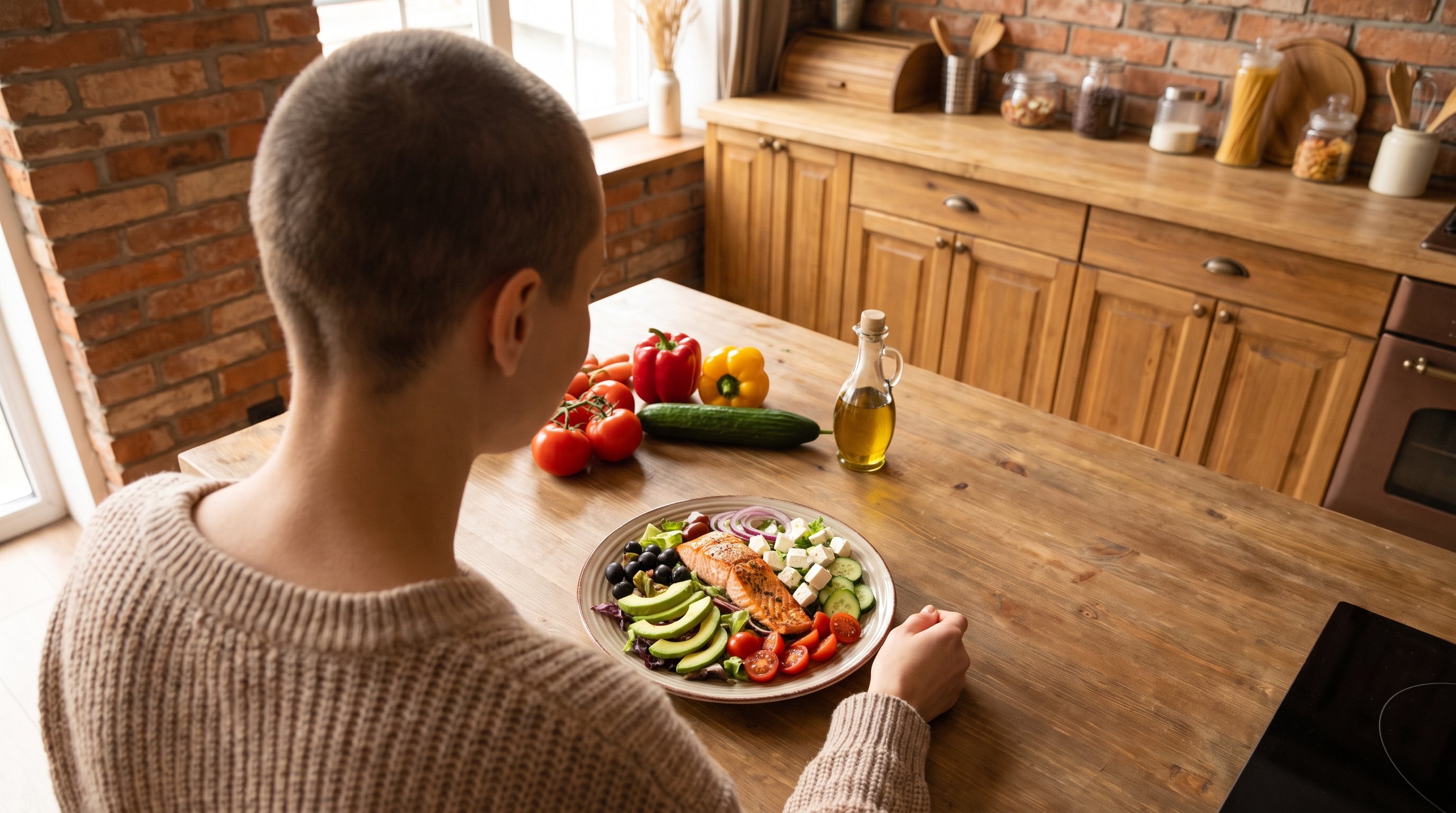
A fat-free salad might sound lighter, but if it leaves you hungry by 3pm and reaching for crackers, the day's total calories can end up higher than if you'd added avocado or a drizzle of oil at lunch. The goal isn't eating more fat for its own sake - it's choosing fats that buy you fullness, so the rest of the day needs less food to feel satisfied.
This is why cutting fat to near zero rarely delivers the result people expect - the body still needs to eat, and it finds those missing calories somewhere else, usually in refined carbs that don't fill you up for nearly as long.
Olive Oil Fats Versus a Low-Fat Diet
Most people choosing a weight loss approach land on one of two instincts: cut fat right down, or swap to fats that work for fullness - like olive oil, nuts, seeds and oily fish - and manage portions instead.
Here's how the two approaches stack up in practice.
| Factor | Low-Fat Diet | Healthy Fat Approach |
|---|---|---|
| Fullness between meals | Often drops off fast | Holds steadier |
| Flavour and variety | Limited, often bland | Wide, Mediterranean-style |
| Ease of sticking with it | Harder over weeks | Easier day to day |
| Common substitute foods | Refined carbs, sugar | Vegetables, whole grains |
| Long-term sustainability | Frequently abandoned | More livable long term |
Neither column is a guarantee of anything - but the pattern is consistent enough that it's worth noticing which one feels doable for a normal week.
Why Swapping Fats Beats Cutting Them Out
The harder alternative is strict fat elimination - reading every label, avoiding oil in cooking, treating nuts as a cheat food. It can work for a week or two, but it asks a lot of daily willpower with no built-in reward.
Swapping butter for olive oil, or a packet of crisps for a small handful of almonds, asks for a decision once, not a battle every mealtime.
Adherence is the whole game with any eating pattern. A plan you can actually keep doing for months beats a stricter one you abandon after three weeks, every single time the maths gets done.

This is substitution, not restriction - the food group stays in the picture, it just changes shape.
Who Benefits Most From Eating More Healthy Fats
If You're Starting From Scratch
Begin with one swap - olive oil instead of a processed cooking oil, or oily fish once or twice a week instead of a processed meat. One change at a time is easier to actually keep.
If Your Days Are Already Full
Fat-forward meals are often the fastest to put together - a tin of sardines, a handful of nuts, an avocado on toast. No extra prep time required, just a different pantry stock.

If You're Managing Blood Sugar
Pairing fat with carbohydrate - olive oil with bread, nuts with fruit - slows the speed at which that carbohydrate hits your system, which can mean a steadier afternoon instead of a crash. isn't something this article can claim without a source, but the pairing principle itself is just food chemistry.
If You're Over 50
Appetite and hunger cues can shift with age, and fat's fullness effect can help meals feel satisfying on a smaller plate. Favouring olive oil, fish and nuts over processed fats keeps the eating pattern simple without extra rules to track.
Making Healthy Fats Fit a Normal Week
None of this requires a kitchen overhaul. It usually comes down to three or four swaps repeated often enough that they stop feeling like decisions.
Easy Swaps to Start With
- Cooking oil - swap a processed vegetable oil for olive oil
- Snacks - swap packaged crisps for a small handful of nuts or seeds
- Protein - add oily fish to one or two meals a week
- Breakfast - add avocado or a spoon of nut butter to a meal that's currently all carbohydrate
This is the kind of structure a meal plan built around food you already like can make easier to repeat - not by handing you rules, but by giving you recipes that already include these fats in sensible amounts. No More Diet builds a Mediterranean-style plan around exactly this pattern, tailored for the way you already eat.
The Myth That Fat Alone Melts Weight Away
No single food - not olive oil, not avocado, not salmon - burns fat or targets any part of the body. That's not how digestion or metabolism works, no matter how a product is marketed.
The body doesn't choose where fat comes off, and no fat source can direct it toward or away from any one area.
What healthy fats can genuinely do is make a lower-calorie way of eating feel less like a sacrifice, because meals stay satisfying. That's a real, useful effect - it's just a different claim from the one the marketing usually makes.
Eating Healthy Fats With Help From No More Diet
Figuring out which fats to prioritise, in what amounts, across a real week of breakfasts, lunches and dinners, is the part that trips most people up - not the concept itself.
No More Diet removes that guesswork with a customized book built around Mediterranean recipes that already balance fats like olive oil, nuts and fish with the rest of your plate. It includes a dedicated section focused on your specific goal, plus practical lifestyle advice so the eating pattern fits your real schedule instead of an idealised one.
Because the recipes are tailored for your eating style from the start, there's no need to translate generic advice into your own kitchen - that work is already done for you.
Eat Without Stress
Eat Clean Every Day
Bringing Healthy Fats Into Tonight's Meal
Pick one meal tonight and add a spoon of olive oil, a handful of nuts, or a piece of oily fish where a processed fat or refined carb usually sits. That's the whole starting move - no overhaul, no list of forbidden foods.
Keep repeating that one swap until it stops feeling like a decision, then add the next one. No More Diet can take that same logic and turn it into a full week you don't have to plan from scratch.
FAQ
It can, mainly because fats like olive oil, nuts and fish tend to keep you fuller for longer, which often means eating less later without trying. It's not the fat alone doing the work - it's the effect it has on appetite across the whole day.
Fat does carry more calories per gram than carbs or protein, but a satisfying fat-containing meal can stop you reaching for extra snacks later. The total for the day often ends up similar or lower, not higher.
Olive oil, nuts, seeds and olives all count as healthy fats and can replace fish or avocado in most meals. No More Diet builds recipes around your actual eating preferences, so you're never stuck with ingredients you don't enjoy.
That usually happens when every meal needs a fresh decision instead of a repeatable pattern. Picking two or three go-to swaps and sticking with them removes most of the daily effort.
Share this post