Meditation For Stress Eating: A Practical Guide
By:Author:No More Diet Editorial
Updated on:October 18, 2026
- Does Meditation for Stress Eating Actually Help?
- How the Pause Between Stress and Eating Forms
- How Often Meditation Fits Into a Stress-Eating Routine
- Why a Short Pause Beats Willpower Alone
- Fitting a Meditation Pause Into a Hectic Day
- The Myth That Meditation Erases Cravings Completely
- What Changes the Result With Meditation for Stress Eating
- Mistakes That Quietly Undo a Meditation Habit
- Pairing No More Diet With a Calmer Approach to Eating
- Starting Tonight With One Short Pause
Meditation for stress eating works by putting a pause between the urge to eat and the act of eating, giving you a chance to notice what you actually need. It doesn't stop stress from happening, and it won't make cravings vanish overnight.
The mechanism is simple: stress triggers a fast, automatic reach for food, and a few minutes of focused breathing or body awareness slows that reaction down enough for you to choose something else, or choose the food anyway, on purpose rather than on autopilot.
This guide covers whether the idea holds up, how the pause actually forms, how often to practise it, and where it fits next to food-based habits you may already be using.
Does Meditation for Stress Eating Actually Help?
The mechanism is about timing, not willpower. Stress eating usually happens in the gap between feeling tense and reaching for food, and that gap can be a matter of seconds.
A short meditation practice trains you to notice that gap while it's happening, instead of only noticing afterwards when the packet is already empty.
Here's the arithmetic version. If a stressful moment to food-in-hand takes ten seconds on a bad day, and a single slow breath takes about five seconds, then two or three slow breaths before you open the cupboard already doubles or triples the time you have to decide.
That extra time doesn't force a different choice. It just makes the choice a choice again, which is the whole point.
How the Pause Between Stress and Eating Forms
Two separate things have to happen for meditation to change a stress-eating pattern: noticing the trigger, and interrupting the automatic response to it.
Noticing the Trigger Before You're Mid-Bite
Most stress eating feels sudden, but it's usually preceded by a recognisable body signal - a tight chest, a racing thought, restlessness. A regular short meditation practice trains attention on those signals so you catch them earlier, before they've already turned into a hand in the biscuit tin.
Interrupting the Automatic Reach
Once you notice the trigger, the interruption itself is mechanical: a few slow breaths, a brief body scan, or naming what you're feeling out loud. None of this requires experience or special skill, and the point isn't to relax fully - it's to create enough of a gap that eating becomes a decision again instead of a reflex.
How Often Meditation Fits Into a Stress-Eating Routine
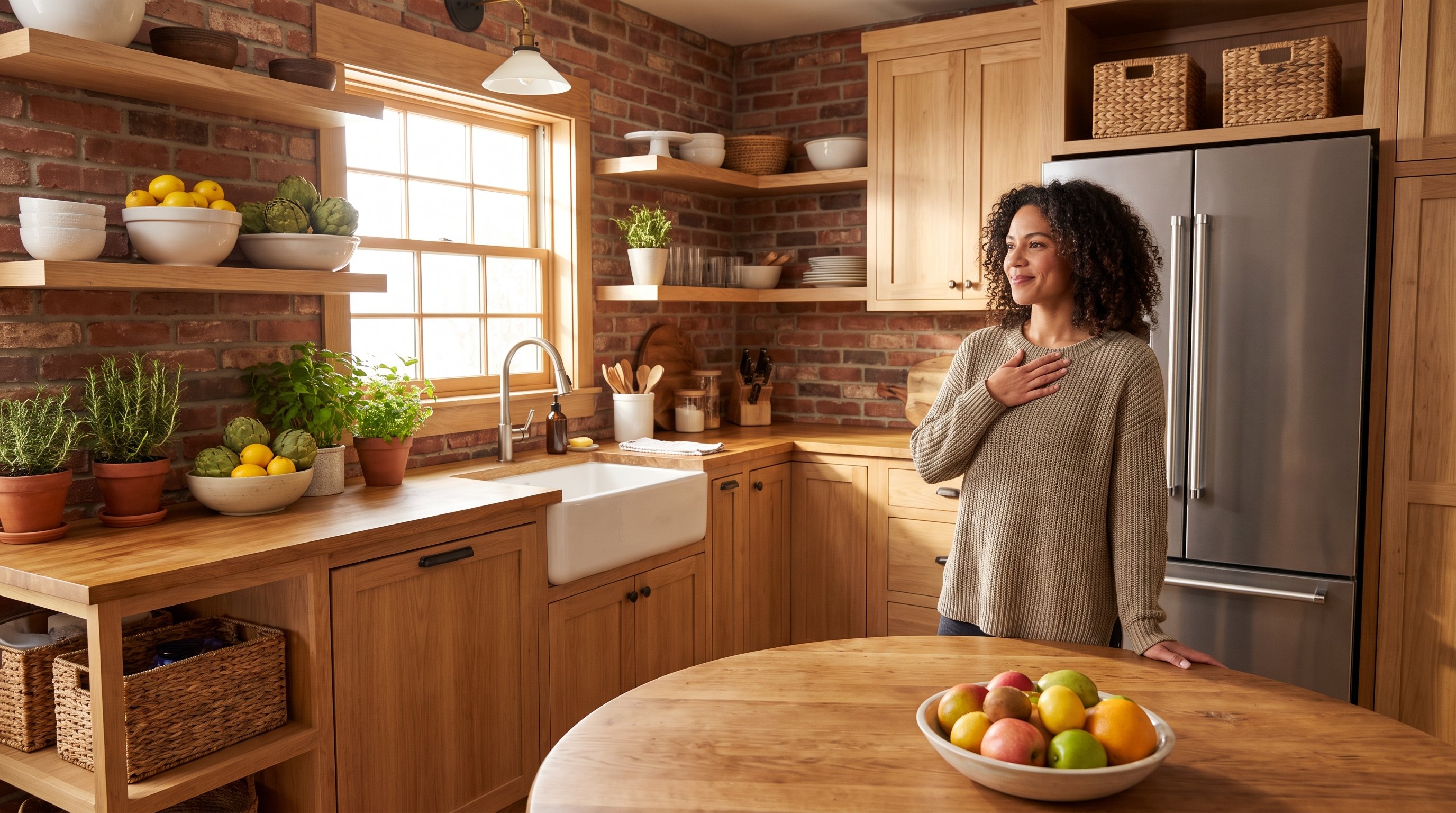
Meditation for stress eating works best as something short and frequent, not as one long session you dread fitting in.
Short and Often Beats Long and Rare
A minute or two at the moment stress hits does more for this specific habit than a single twenty-minute session once a week, because the goal is to be ready at the exact point a craving shows up.
The table below gives a rough starting structure you can adjust to your own week.
| Moment | Practice | Purpose |
|---|---|---|
| Morning | 2 minutes breathing | Set a calmer baseline |
| Before meals | 3 slow breaths | Check real hunger |
| Stress spike | 1 to 2 minutes pause | Interrupt automatic reach |
| Evening | 5 minutes body scan | Unwind the day's tension |
| Weekly | One longer session | Reinforce the habit |
Why a Short Pause Beats Willpower Alone
The harder alternative here is white-knuckling it - relying on willpower to resist a craving the moment it hits, every single time, with no tool in between.
Willpower is a limited resource on a stressful day, and it tends to run out exactly when you need it most.
A short meditation pause doesn't ask you to resist anything. It just buys a few seconds, which is a much smaller ask than holding a line all evening, and that's why it tends to stick where pure resistance doesn't.
Fitting a Meditation Pause Into a Hectic Day
A meditation pause has to survive real conditions - a loud kitchen, a short lunch break, a phone that won't stop buzzing.
It works because it needs no equipment and no quiet room. A tense moment at your desk or in the car counts just as well as a calm one at home.
What it can't do is decide what you eat once the pause is over, which is where having a meal plan built around food you already like matters - No More Diet gives you that structure, so the calmer moment you've just created has somewhere useful to land.
The Myth That Meditation Erases Cravings Completely
Some people expect meditation to switch off cravings entirely, as if enough practice means stress stops triggering the urge to eat at all.
That's not how it works, and it isn't how any single habit works on its own. Stress will keep showing up, and food will keep being one of the fastest ways to feel better in the moment.
What meditation actually does is make the response to that stress slower and more deliberate, not the stress itself disappear. The real win is choice, not immunity.
What Changes the Result With Meditation for Stress Eating
Not every attempt at this gets the same payoff. Three things tend to matter more than the rest.
What Moves the Needle Most
- Consistency over intensity - a short pause practised daily does more than one long session used occasionally
- Catching the trigger early - noticing the body signal before the cupboard door opens matters more than the breathing technique itself
- Having food ready that you actually like - the pause only helps if what's waiting afterwards feels satisfying, not punishing
Mistakes That Quietly Undo a Meditation Habit
Saving It for a Crisis
Only reaching for meditation during the worst stress spikes means you're practising the skill at the hardest possible moment. Practise it on ordinary days too, so it's familiar by the time you really need it.
Treating It As a Punishment for Eating
If meditation only shows up after you've already eaten something you regret, it starts to feel like a penalty rather than a tool. Use it before the moment, not as damage control after.

Expecting Instant Calm
A minute of breathing won't always feel peaceful, especially at first, and that's not a sign it isn't working. The point is the pause it creates, not the feeling it produces.
Leaving Nothing to Eat After the Pause
If the kitchen only has food that feels like a compromise, the pause ends with the same frustration it started with. Keep meals on hand that you'd choose even without the stress.
Pairing No More Diet With a Calmer Approach to Eating
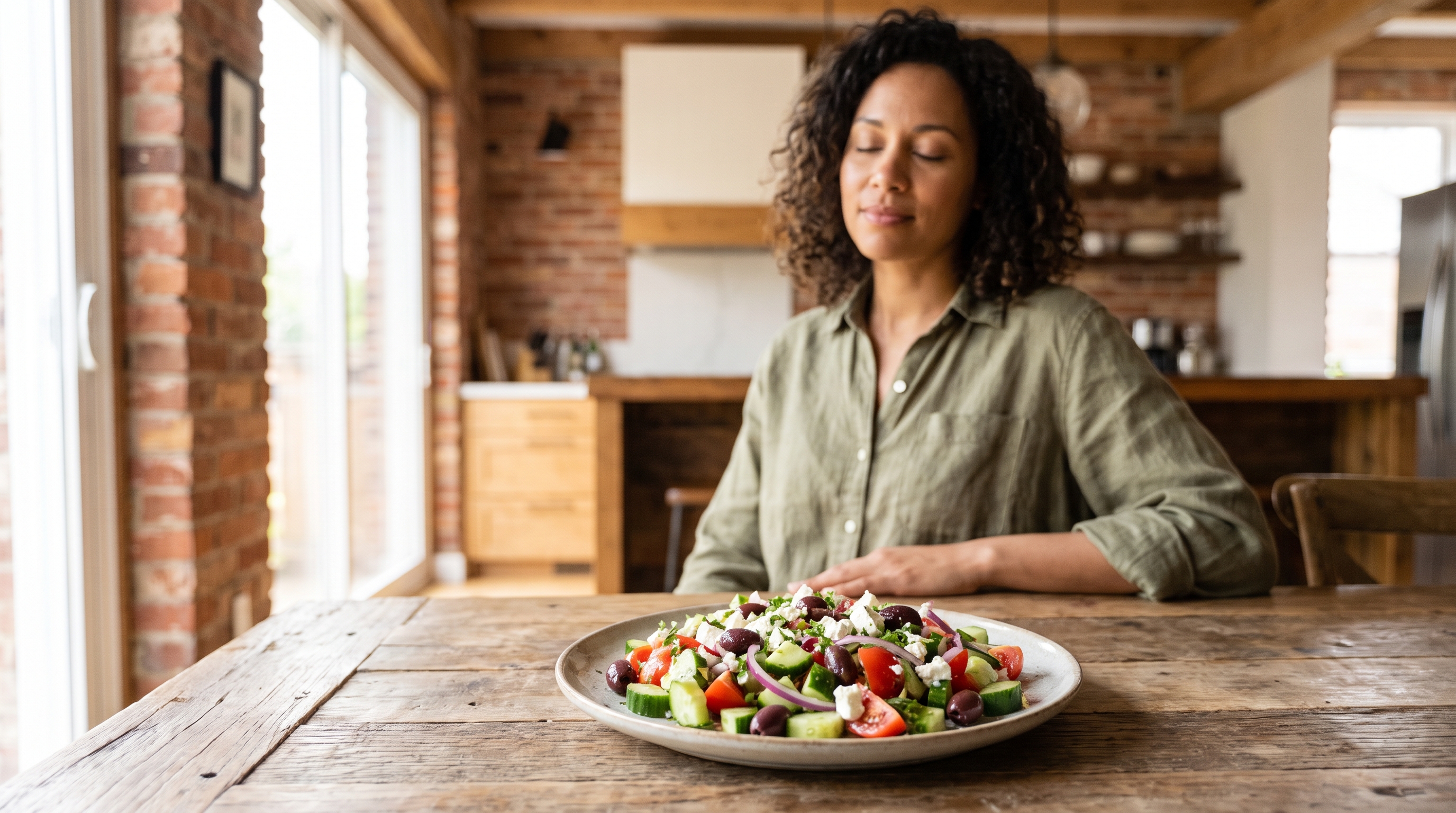
A meditation pause creates the moment of choice, but it doesn't fill your fridge or plan your week - that's a separate job, and it's one most people underestimate.
No More Diet is built as a tailored Mediterranean diet book, with recipes that match your eating preferences so the choice waiting on the other side of that pause is actually appealing, not something you're settling for.
It also includes a deep-dive section built around your specific goal, plus lifestyle and nutrition advice designed to work in real life rather than in theory, so the calm you build through meditation has a practical plan to meet.
Eat Without Stress
Eat Clean Every Day
Starting Tonight With One Short Pause
Pick one moment today - before dinner, after a stressful email, whenever the day gets loud - and try three slow breaths before you decide what to eat.
That's the whole starting point, and it costs nothing but a few seconds.
If you want the other half of the equation sorted too, No More Diet gives you food worth reaching for once the pause is done, so the calmer moment actually leads somewhere satisfying.
FAQ
It doesn't stop the urge from appearing, but it slows down the automatic reach so eating becomes a choice rather than a reflex. Over time that pause can change the pattern, even though the stress itself keeps happening.
That's normal, especially early on, and it doesn't mean the practice has failed. Try stacking a longer pause - a short walk or a body scan - on top of the breathing, rather than abandoning the idea entirely.
Meditation for stress eating doesn't need silence or a special room - three slow breaths work in a car, a corridor or at a desk. The point is a pause, not a setting.
That's exactly where a plan matters, since the pause only creates a decision point, not the decision itself. No More Diet gives you Mediterranean recipes you actually like, so the choice after the pause feels like eating well, not giving something up.
Share this post